Are you still confirming reservations by email, comparing supplier rates in a spreadsheet and re-keying the same reservation three times? If so, there is one upgrade that will fundamentally change the way the whole business operates: travel booking software.
It is not a preferred option for most companies on a quiet afternoon. They come to a turning point. The peak season morning when two agents sell the same allotment. the reconciliation process that takes four days for a finance team because each supplier invoice is saved in different inboxes. The inquiry became dormant as no reply was received for nine hours. Travel booking software is the system that ends those days; a single platform that enables the sale of flights, hotels, transfers, tours, cars, cruises and packages, as well as the storage of inventory and rates, payment processing and the transmission of each transaction to the back office for invoicing and reporting, instead of the dozen or so disjointed tools that most companies initially implement.
This manual is intended for the person who is responsible for making the decision. It covers things like what the software actually is (and how much the marketing department is overselling it), what sort of software you may encounter, how the system becomes integrated with airline and hotel inventory, what the differences are between a serious platform and a web form, a detailed guide on how to choose the right software, pricing for 2026, and how a rollout actually happens. If you are a destination management company, a tour operator, an OTA or a growing agency, you will know what to ask for and what to say no to.
Travel booking software is a real time platform that combines search, inventory, booking, payments and back office accounting – replacing email, spreadsheets and disconnected point tools.
Statista, Grand View Research and Global Market Insights estimate the global online travel market to be worth around $700–713 billion in 2025 and to surpass $1 trillion by the end of the decade, with more than 70% of travel sales currently made online.
There is no single platform that is considered the 'best'. The right fit depends on your model (OTA, tour operator, DMC, TMC, agency) and if you are selling B2C, B2B or both.
The real differentiator is connectivity, not the look and feel of the booking widget. GDS, IATA’s NDC standard, bedbank aggregators, and a channel manager are far more important.
Evaluate the vendor’s integrations, scalability, security certifications (SOC 2, ISO 27001, PCI DSS), total cost of ownership, and support. Then, schedule a live demo using your own scenarios before you sign.
You take away the marketing and the travel-booking software, and there is a coordination layer. It sits between three groups that would otherwise never communicate effectively: your suppliers (airlines, hotels, transfer companies, activity providers), your sales channels (your website, your agents, your B2B partners) and your back office (operations and finance). Its job is to make sure all three are in real time alignment.
The “software” is usually made up of a number of components that work together, and it is helpful to give them names, as vendors use the terms loosely.
The booking engine is the face of the system. It is the search box that provides instant results and converts a query into a paid reservation. Your contracted inventory, rates and allotments are maintained within a central reservation system (CRS). A channel manager keeps your inventory consistent across all your sales channels, so if a room is sold on your website, it is removed from the OTAs before it is double-booked. The operational middle is a mid-office, which handles the processing of quotes, vouchers, supplier confirmations and amendments. And the back office is responsible for managing the money: invoicing, supplier payments, commission tracking, tax, reconciliation.
The first one is offered by a website with a payment plugin and the others are not included. This is the gap that leads to a lot of agencies that “have online booking” still doing the actual work by hand. All this is linked by appropriate travel-booking software, which allows you to book a reservation at 2 a.m. Before the first laptop is opened, the system updates inventory, fires a supplier confirmation, captures the payment, issues the voucher and deposits in the accounts.
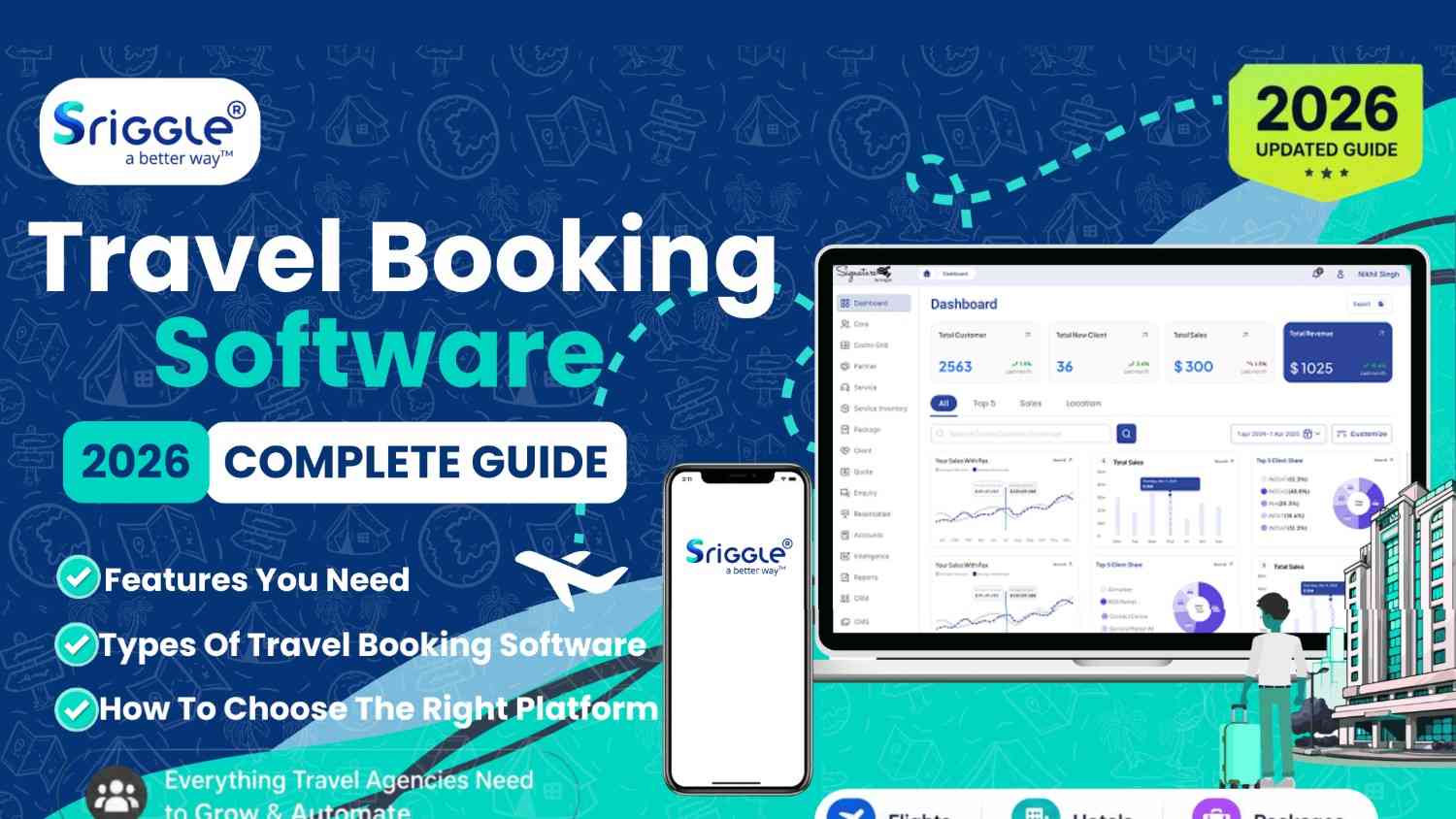
In a manual process, each of these steps involves a loss of time or money. The software is plugging the holes. For those who would rather watch the process unfold than read about it, Sriggle’s travel booking engine offers a full picture of the whole process from search to settlement.
Having a modern booking platform is no longer a competitive advantage, it is a necessary expense to stay in the game. The data on this is uncomfortably explicit.
The 2025 value of online travel was around $700-713 billion, and the major research institutions mostly agree that it will exceed $1 trillion in the next decade and continue to grow to around $1.4 trillion by the mid-2030s (Grand View Research, Global Market Insights). For operators, the channel split is more informative. Online channels represent more than 70% of all travel and tourism revenue today, and this is still growing, according to Statista.
Then there is the way in which people buy things. By 2025, mobile will represent around 63% of online bookings, and the trend line shows this will reach seventy percent in a couple of years, according to Mordor Intelligence. Another observation is the collapse of decision windows: Skift reports that 40% of U.S. hotel bookings in June 2025 were made within seven days of arrival, and last minute bookings now account for about 21% of global bookings. This underscores the importance of real-time availability and instant confirmation. Businesses that can package and cross-sell are rewarded, with 77% of travelers being at least somewhat likely to book more than one part of a trip on the same platform (35% “very likely”). Additionally, travelers are increasingly looking for everything in one place: Expedia Group’s 2026 global research found that 77% of travelers are at least somewhat likely to book more than one part of a trip on the same platform (35% “very likely”).
The global OTA market is also very concentrated at the top, with IMARC Group estimating that Booking Holdings and Expedia Group together have a market share of about 65%. The practical lesson for independent operators is not to outspend the giants, but to eliminate the operational drag that keeps them from competing on service, speed, and curation. That’s exactly what booking software does.
Travel booking software is a category, not a product. What you need depends on three questions : who is your audience? What are you selling? What problems do you try to solve? The easiest way to segment the market is generally to segment it by audience for buyers.
B2C systems are the best starting point for online and retail growth, because they allow you to sell directly to consumers on your branded website or app. B2B systems create a portal through which sub-agents, corporate clients and partners can book against your negotiated rates and credit terms, and this is often the highest-margin channel available to wholesalers and consolidators. B2B2C and White Label platforms allow you to sell your inventory through partners under their brand, allowing you to distribute without increasing staff. That is why you need an all-in-one platform, there are many established companies that do all three at the same time. The process of combining separate B2C, B2B, and B2C tools becomes expensive and unstable right away.
Other product line descriptions are software for flight bookings, hotel bookings, car rentals, cruise bookings and activities or tours. Single-product tools are easier and less expensive, but they lock you into silos when you try to market a packaged trip. The value of a unified platform grows as it incorporates more and more products.
This is what the experienced buyers are looking at, while the demos gloss over. Booking engines are only as good as the content that goes in. And that's because the way they get rates for flights and hotels can make two platforms look the same on screen, but be very different in reality. You need to understand the four main routes; it is in connectivity that deals are quietly won or lost.
The legacy backbone of air and, to a lesser extent, hotel and car distribution is GDS, Amadeus, Sabre and Travelport. They use EDIFACT, a messaging standard that was developed before the web, and provide access to a broad spectrum of global air content through a single connection. They’re still critical to most agencies, but they were never designed for the affluent, retail-style merchandising.
NDCs This is the biggest change to airline distribution in a generation and needs a strong platform to be able to support it. New Distribution Capability is an IATA standard that enables airlines to send fares, ancillaries and personalised offers directly to agencies and booking platforms, either bypassing or supplementing the GDS, using XML. Over 70 airlines are now approved on IATA’s Airline Maturity Index, Amadeus has said, and airlines including Lufthansa, Emirates and American are withholding their best bundles and lowest fares for NDC channels. That means an agency without NDC access may not be able to show the lowest fare on screen. There is a separate field to source it. You can connect directly to each airline. You can connect via a flight aggregator such as Duffel, AirGateway or Travelfusion. Or you can connect via the GDS which pulls multiple carriers under one API.
Bedbanks and aggregators. Most organizations don’t contract out each property for hotels and ground transportation. They are tied to wholesalers and aggregators such as Hotelbeds, WebBeds, TBO (Travel Boutique Online) and GRN Connect, which expose hundreds of thousands of properties via one integration. Activity content provided by Viator, Musement and GetYourGuide among others.
A channel manager on top of your own contracts. DMCs and many tour operators negotiate the net rates and allotments directly with the suppliers. Your inventory is in your CRS, and a channel manager ensures it syncs to your website, your B2B partners and the OTAs so you don’t double-book that room.
Here is the exact location where platform depth is shown. Sriggle has over 200 ready-made API integrations including GDSs (Sabre, Travelport), bedbanks (Hotelbeds, TBO, WebBeds), activity suppliers and payment gateways. And the problem isn’t so much the headline number as the fact that the necessary connections are already in place, so you can fire it off in weeks rather than the laborious process of building integrations contract by contract.
It’s easy to get caught up in a clean out. Continue to fight it. The main feature that makes the software profitable is not what the customer knows. Configure your assessment like this.
First reservation. Avoid selling what you don't have by tracking real-time availability and pricing from all connected sources. A comprehensive search across flights, hotels, cars, cruises and activities in a single flow. The packaging is dynamic, and it combines the products with rules and markups that are constantly applied. A mobile booker who books on the last-minute is impatient and needs instant confirmation and document generation.
Regulations and Pricing. We include promotions and coupons, configurable markup by channel or product, net-rate handling, fare and cancellation rules and per-product profitability to make sure you can see margins as well as revenue.
Disbursement. Multi-currency capture and settlement, agent credit lines, stored cards for returning customers and fraud screening, multiple gateways. When it comes to international travel, payment flexibility isn’t just a “nice to have,” it’s the difference between a conversion and a loss at the last hurdle.
Back office . Air supplier and contract management, allotment management, auto invoicing & reconciliation, commission management, forex, tax management and BSP/ARC settlement. This is the unsexy part that decides if you’re actually saving time, or just pushing the spreadsheet down the line.
Customer experience and operations. A mobile first booking flow (non negotiable as most bookings start on a phone), multi currency and multi-lingual support, integrated CRM for quotes and repeat business, and role based permissions to make sure agents, partners and finance only see what they need.
Reporting and Security. Live dashboards deliver sales, margin and product performance, underpinned by recognised security measures including PCI DSS for card data and SOC 2 and ISO 27001 for the platform. Certifications should be a hard filter, not a footnote, as you will be storing payment details and passport numbers.
That’s a real benefit and it compounds. You can sell 24/7, across time zones, without having to staff someone on the night shift. Automation eliminates the silent money drain of double entry errors and the loss of trust from suppliers. You reduce your cost per booking by enabling your staff to focus on high-value sales and exceptions, rather than rekeying reservations. Customers get self-service, clean itineraries, and instant confirmations. Margins are improved by automatic markups, packaging and cross-selling. Plus, for the first time, you will get live access to the products that are actually selling and making a profit.
And the trade-offs are set to be equally honest. Good software requires an investment of money and more importantly change. Inevitably the first few weeks show edge cases that your previous process hid . Data migration , re-educating staff , etc . Companies that gain the most from the rollout approach it as a project with a designated owner, not a switch to be flipped. Further information about this matter is given below.
There is no one size fits all platform. The choice depends on whether the platform fits your model, your suppliers and your roadmap. This sequence ensures that the decision remains grounded.
Initialize model. B2B, B2C, or both? Leisure, corporate, inbound or mixed? Answer shows which features are necessary and which are not. Don’t pay for a feature set designed for a business you’re not running.
Then check connectivity by mapping suppliers and products. Please list all the products you sell and all the suppliers, GDS, aggregators or airlines you require and please confirm each is integrated already. The single biggest cause of budget and schedule overruns over the life of a project is the building of a missing link.
Real back office needed. The visual front end merely relocates the manual work and is connected to a weak accounting system. Demand flows end-to-end from booking to ledger.
Scalability should be tested against load. Ask the platform about its handling of high volume situations (e.g., a 300-person group, flash sale, or Black Friday traffic). Ask about uptime and search response times for cloud-native, multi-tenant systems which can scale and update without painful re-platforming.
Consider security as a barrier. SOC 2, ISO 27001, PCI DSS, and GDPR/CCPA readiness isn’t about ticking boxes. That’s up to the vendor and how specific they want to get.
Calculate exactly how much it costs. Add in setup, subscription, per-booking fees, integration, payment processing and support into one total-cost-of-ownership number that is realistic over a three-year horizon.
Evaluate the vendor, not just the product. The depth of the travel domain and responsive support is always more important than any feature and is the factor that makes implementation successful. A great product with no contact is no match for a competent team with an acceptable product.
Do a live demo with your own data. Ignore the automated walk-through. Before signing anything ensure that the system can handle a real booking, a refund, an amendment, a multi currency payment and a month end report.
Want to combine steps 7 and 8 in one afternoon? You can ask for a demo and test your own scenarios with a specialist, not a sales script.
A handful of big players develop their own platforms. For most people, the most economical, efficient and risk-free option is to buy a system already known to work. A third option, also worth mentioning, is a configurable or white-label platform that can be heavily customized without having to write the core from scratch. This is usually the ideal solution for ambitious operators who need their own identity, but are not able to justify a multi-year build.
Either way, the failure patterns are predictable: buying at the sticker price and then finding the required integrations aren’t there; underestimating the back office; treating mobile as an afterthought; skipping security due diligence; and choosing a rigid system that you outgrow within two years. It is better to detect those traps early than to compare features.
The products are so different it is very difficult to compare prices, but the models have been cut down to four.
SaaS is a subscription service that generally offers a flat monthly or annual fee that is tiered on features, users, or booking volume. Tour and activity tools for entry-level tiers are typically around $49–$99/month, while enterprise travel platforms are quoted on request. A per-booking or transaction fee is an additional, nominal fee charged for each reservation. Direct-booking software charges a fee, usually between 1% and 8%, per booking. It doesn’t seem like a lot until you multiply it times your volume annually. It is, therefore, a necessary calculation. Setup and Implementation Fees are one-time fees for configuration, data migration and integrations. Custom / Enterprise Pricing also includes sophisticated, high volume or highly customized deployments.
If you are distributing via OTAs like Viator, GetYourGuide or Expedia, realize that they usually take a 15-25% commission on each booking. Which is why you should develop your own direct-booking capability, instead of leasing someone else’s audience for eternity.
The smarter question is not “what is the cheapest?” but rather “what will this cost me in actual bookings, in terms of staff time saved or wasted?” A platform that offers more advanced automation and pre-existing integrations will often win out over a cheaper tool that requires constant manual workarounds and custom development. The most pricey thing you can do is to buy cheap software that degrades the performance of your team.
Even the best software can be a disappointment if the rollout is rushed. A realistic implementation consists of five phases. In discovery and configuration your workflows are mapped and products, suppliers, markups and user roles are setup. The step that will likely surprise you the most is the integration and data migration that connects your GDS, NDC, aggregator and payment endpoints and cleanly moves your current bookings and client records. So make sure you allow time for this process. Testing includes full run of real transactions including bookings, refunds, amendments, multi-currency payments and full reporting cycles. Training prepares staff and partners to be confident before the launch, rather than after. You take it live. You optimize it. You launch. You tune the system against real data.
“We’re talking a few weeks for a focused single product setup, and a few months for a full multi-product, multi-channel platform that requires a lot of integration work.” The most important variable is not the software, it is the vendor. Generic software shops that are learning your business on your budget move very slowly compared to teams that have deep travel domain experience and real support.
Once you have a short list, the vendor is as important as the feature list and sometimes more important. Sriggle is a travel technology company that specializes in this area, not a generalist with a travel module. Founded by travel technology veterans whose careers span more than 30 years in the industry, including leadership experience at global operators like Kuoni Travel Group, a team of more than 100 travel experts and more than 100 clients serving in 190+ countries including renowned brands such as Yatra and TUI India.
This is a joined-up architecture and it is the integrated finance module of the flagship platform, Signature, that this guide continues to emphasise. It is a cloud-based system that links the front office, mid office and back office. The portfolio is rounded out by a small product family: SigniA, a white label portal and AI-assisted B2B agent, SigniP, a partner extranet for suppliers and resellers and Signix, a cloud API layer for real-time connectivity.
The following are often attractive to operators:
With 200+ pre-built integrations across GDSs, bedbanks, flights, activities and payment gateways, connect with the suppliers you already use instead of starting from scratch.
Not a one size template but a solution to fit all models, be it OTAs, tour operators, DMCs, MICE or travel agencies.
Enterprise-grade security Certified SOC 2, ISO 27001, and PCI DSS Compliant with GDPR and CCPA
Rated 4.8/5 on Capterra. We have offices in India, Dubai and London to support you round the clock.
Would you like to know how it would manage your suppliers, products and channels? The only way to get the honest answer is to run your own scenarios, so I’d recommend you schedule a complimentary demonstration.
One of the most important decisions any travel business will make is choosing the right travel booking software. This decision will determine the number of bookings they will be able to handle, the margin they can make on every booking and how fast they can grow without burning out their staff. A big shift has already happened in the market: More than $700 billion in online sales, more than 70 percent of sales in the digital realm, mostly on mobile devices, and in a more and more last-minute manner. Travelers expect a yes on the spot and the organizations that can give it are those that run automated systems.
Use the framework out. Build your model, connect your suppliers, and check your connectivity. Expect a real back office, security as a gate, cost it over 3 years, and always test on your own data before buying. Once that is done, the software is no longer a cost, but a way to recover cost through time saved, bookings captured and cleaner margins.
Are you ready to find the right platform for your business? Ask for a free demonstration of Sriggle’s travel booking software, custom built to your own products, suppliers and workflows, and speak to a travel technology expert. Or contact the team to talk about your needs.