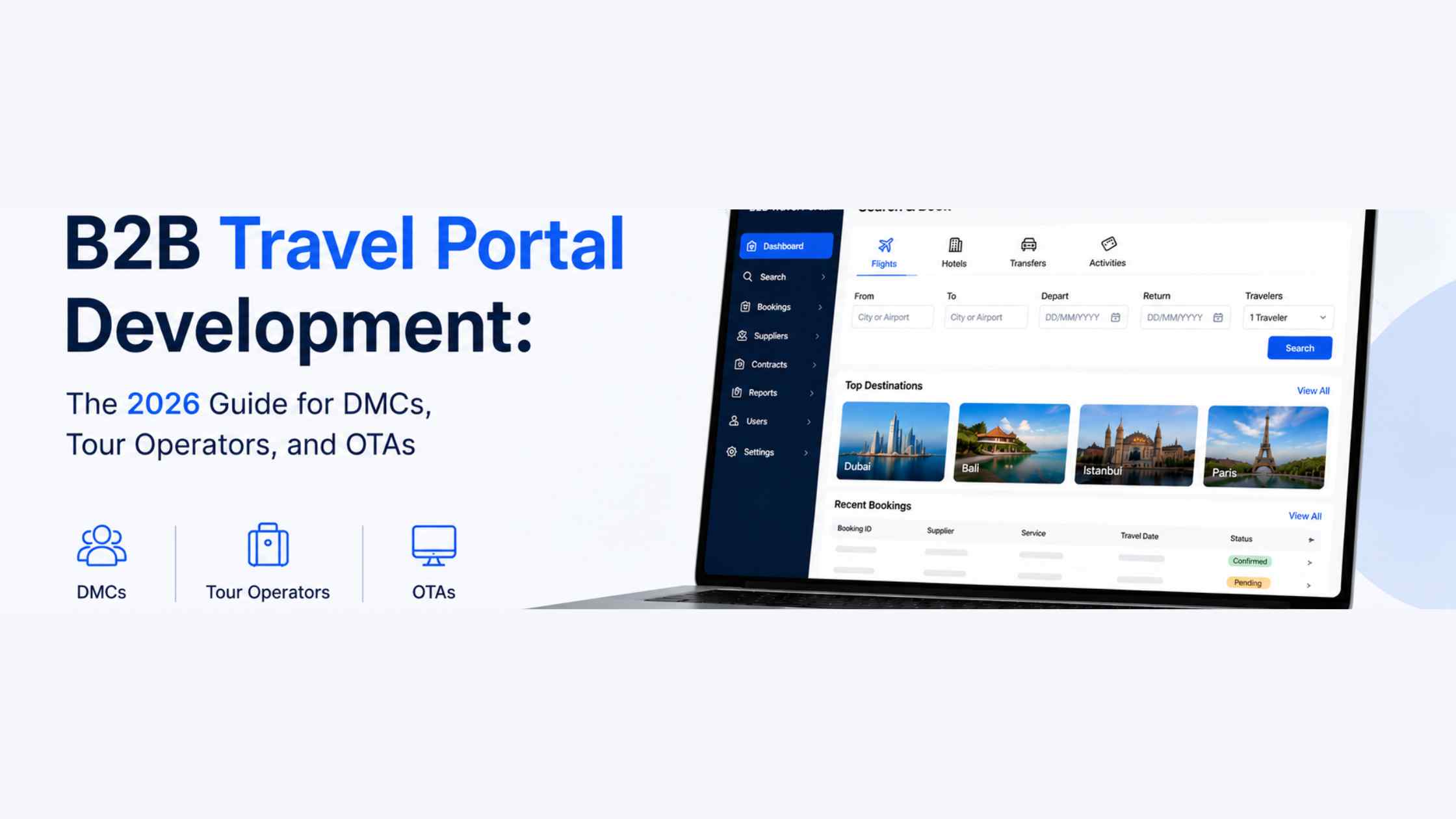
A B2B travel portal, is a login based interface where the trade partners — be it sub agents, tour operators, corporate buyers — have access to your inventory; they can search, view net rates and make instant bookings without having the hassle of sending your team mails on every request.
So here's why that matters now: Your largest tour operator partner just asked you for a login. Not a quote by email, not a PDF rate sheet, but a login, with live availability and instant booking. If you can't give them one, they'll find a DMC down the road who can.
That’s the trend that is informing all discussions about B2B travel portal development today. The rate sheet email is dying. Partners that once put up with it — tour operators, sub-agents, corporate buyers — now want the same self-serve experience they get with any other B2B software provider.
Whether you need to call it a B2B travel portal, partner extranet, retailer network platform, or a B2B booking engine, the expected result is the same — partners want to search, quote and confirm without waiting on a human.
A B2B travel portal is a login-gated booking platform that lets your trade partners — sub-agents, tour operators, and corporate travel buyers — search your inventory, see your negotiated rates, and confirm bookings without emailing your team for every request.
It's worth pausing here, because the term gets used loosely. If you searched this term expecting to compare tools like SAP Concur, Navan, or TravelPerk, you're looking for corporate travel management software platforms built for companies booking and approving employee travel, with expense integration and policy enforcement. That's a different category, built for a different buyer, solving a different problem.
This guide covers the other meaning: distribution portals. The systems that let a DMC, tour operator, or OTA sell through a network of trade partners instead of one transaction at a time. In industry terms, you'll also hear this called a B2B booking engine, a partner extranet, or an agent network platform — different vendors use different language for largely the same category of system.
The buyer profile is consistent across the market:
Destination management companies (DMCs) distributing ground services: hotels, transfers, excursions to inbound tour operators and travel agencies in source markets.
Tour operators selling packaged itineraries through a network of retail and online sub-agents, often across multiple countries and currencies.
OTAs and wholesalers distributing aggregated inventory (their own contracted product plus third-party content) to a B2B agent network rather than direct consumers.
Travel agencies with their own sub-agent networks, who need to extend their own negotiated rates downstream without manually re-quoting every request.
What unites all four is the same underlying need: a system that enforces partner-specific pricing automatically, instead of relying on someone in operations to remember which agent gets which markup.
Three pressures are converging at once.
Partners expect self service: a tour operator that deals with a dozen DMCs doesn’t want to send an individual email to each one. The DMC with a portal gets searched first, quoted first and booked first not because the inventory is better, but because the friction is lower.
Manual processes don’t scale to a certain volume: when you’re dealing with rate sheets, availability updates and booking confirmations for more than a handful of active partners, email and spreadsheets stop being workflows, and start being bottlenecks. There’s always someone waiting on a reply.
Margin visibility is more important under stress: With multi-currency supplier contracts and partner-specific pricing tiers, manually calculating how much each partner owes and how much each booking earned — is error-prone fast. A portal which links pricing rules directly to a booking engine eliminates the guesswork.
None of this is new in concept. The change is that now the partners at the receiving end of that relationship have a baseline expectation. Shaped by every other B2B software category), that self-service is table stakes.
Not every platform marketed as a "B2B travel portal" includes all of these. This is the actual functional checklist.
Every trade partner is given a specific username which is unique to their commission rate, credit limit and also the stock visible to them. A sub agent in one market can get rate different than a wholesale partner in another – it should do it automatically, not trust someone’s memory – to apply the right margin.
Partners must be able to view live availability, and your actual contracted net rates, instead of a static ‘rate sheet’ which is three weeks out of date. It's the one functional difference that far more advanced solutions have in comparison to a glorified contact form with a login screen.
Pricing is not a number but layers in B2B travel: net rate, partner-specific markup, currency conversion, and sometimes a sub agent’s own markup on that. The portal should consistently execute these rules for all bookings, and not need to be manually overridden.
A lot of B2B portals under DMC and wholesale operate on credit limit system and not payment in advance per booking, which means partner books against an agreed credit line and makes payment as per agreed billing cycle. It’s common enough in the category that it should be a question you ask of any platform you’re evaluating, rather than an assumption.
If you want your partners — or sub-agents — to access the portal as your platform without your brand getting in the way, white-labeling has to go beyond a logo swap. Brand color schemes, domain, and e-mail confirmations should be branded on your partner's if that's what the deal structure involved. Consult the section on white-label travel portal development to see how this is typically executed.
A booking made on the partner portal should automatically flow into your operational & finance system. This is where many ham-fisted solutions break down: the portal is beautifully designed, but bookings still arrive in somebody’s inbox where they’re keyed in by hand.
The portal is only as good as what backs it. Check which GDS and supplier connections the platform supports in production, not only in a list of features. Sriggle is live and certified with Travelport (Galileo) and Amadeus; Sabre is not currently supported, so if Sabre content is in your inventory mix, confirm that distinction directly.
This connectivity is located behind SigniA, Sriggle's B2B white-label agent portal layer, with SigniX managing the core API communications with external suppliers and GDS platforms. Payment gateway support is none other than Stripe and PayPal for all the plans, and each plan comes with a dedicated onboarding manager, instead of making that support enterprise-tiers-only.
This is the part most vendor content either skips or guesses at. Here's the realistic breakdown — and if you haven't already, our travel booking software guide covers the equivalent cost/timeline tradeoffs for the broader booking platform decision, not just the B2B portal layer.
You're running on the infrastructure of an existing system — with your branding, your rates and rules, and your supplier connections all plugged in to it. On a platform such as Sriggle's, templates are live in approximately two weeks — the booking engine, payment processing and base architecture are already in place, so what’s being tailored is the specific business logic of yours over that.
More complex implementations, involving more intense supplier integration or customized partner tiering, will take more time; get an honest average from any vendor, not just their ‘best case’.
You own every line of code and every architectural decision. if your business model really doesn't conform to any of the assumptions of the existing platforms — but it's a marathon, usually measured in months, and the ongoing maintenance burden (security patching, GDS API version changes, uptime) falls on your team in perpetuity.
Good to know before any sales call: a SaaS-based, per-user annual license model is becoming typical for B2B portal platforms — not a commission on booking. With Sriggle specifically, there is no per-booking transaction fee and no setup or implementation fee included in the license. Each license grants three agent portal logins, and you can buy additional logins are available above that base tier — a point definitely worth confirming with any supplier, since “unlimited agent seats” is a common — but frequently inaccurate — claim in this space. The B2B agent portal and sub-agent management features are available from the mid-range Professional tier and up; not locked behind an enterprise-only tier.
The middle road that most developing DMCs and tour operators are finding is a modular platform solution – one purpose-built for B2B distribution, not retrofitted from a B2C booking engine – that can be scaled with partner modules as their network expands, without having to replace a full system down the road.
A question to ask any provider directly, whichever path you decide on: was this platform built from the ground up for B2B distribution, or is it primarily a B2C booking engine with a partner login slapped on afterward? The difference is in the places that matter most — the flexibility of pricing rules, credit management, and the elegance with which bookings flow into your back office.
Most DMCs and tour operators are in fact deciding among three approaches, not two. The legacy practice — agents booking directly on GDS terminals or through emailed pdf rate sheets — is still sufficiently widespread to merit explicit mention, since it’s the baseline that many up and coming operators are moving away from.
The legacy column isn't some strawman — it reflects the reality for most operators considering a B2B portal today. The real rationale for leaving it isn't some abstract “digital transformation” buzz term; it's that manual quoting can't scale beyond a certain number of partners without adding headcount, and a platform-based agent network lifts that ceiling without requiring a full-time engineering team.
A useful checklist for vendor calls and demos, past the power features page on the pricing sheet:
The time you spend asking most of these questions is 30 seconds – and you might save yourself weeks of post-contract surprises.
B2B systems manage partner payment credit terms, negotiated rate information and booking volumes that translate into real revenue risk. A few things are always worth double checking with any platform, instead of assuming:
Data security certification: Inquire about which certifications it (ISO 27001, SOC 2, etc.) currently has hold, historically had held, and/or is in the process of acquiring and support marketing statements with documents Sriggle is ISO 27001 and SOC 2 certified.
Payment handling: If the portal involves direct payment (as opposed to solely credit-based booking), check for PCI DSS compliance, and whether card details are tokenized rather than being stored on the firm's servers. Sriggle is PCI DSS v4.0 certified.
Access control and audit trail: You’ll want a system that tells you which user made changes to a rate, approved a booking, or adjusted a credit limit, not just which user logs in, with different partner tiers and internal users.
You can also use it as a handy due diligence template to pass directly to partners – most B2B portal vendors will make security assertions in marketing copy, without a certification number, audit date, etc.-attached. Asking for the specific standard, version, and certifying body quickly weeds out a lot of noise.
A B2B travel portal is not a feature of a website but rather the foundation that your partner network operates on. The platforms that fail partners are not those simply missing a checkbox on a feature list, they are fundamentally backwards – built on a B2C booking engine with B2B functionality tacked on, rather than designed from day one with how trade partners actually work: tiered pricing, credit-based booking and a back office that doesn't force them to hand enter data.
If you're shopping platforms—ask the architecture question first—was this built with B2B distribution or is this distribution an accommodation to an existing platform—before you start asking about features. The answer is everything else is predicted by it.
For a demonstration of how this works on a platform designed for B2B distribution from the ground up, our B2B travel portal development page provides a detailed view of SigniA's unique capabilities.